


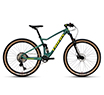

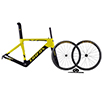
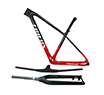





The mountain biking industry has long sold us on a simple message: stiffer is better. Stiffer frames, stiffer wheels, stiffer cockpits. The logic seems impeccable—less flex means more power transfer, more precise steering, and a bike that goes exactly where you point it. But like many simple truths, this one overlooks a crucial nuance. Real-world trails are not smooth, predictable tracks. They are chaotic tapestries of roots, rocks, off-camber turns, and sliding loam. On such terrain, an extremely stiff bike can actually hold you back. A frame with just the right amount of lateral compliance—controlled side-to-side flex—can improve traction, enhance cornering confidence, and reduce fatigue, transforming a good hardtail into a great one. The Trifox SDY21 carbon hardtail embodies this balanced philosophy, proving that sometimes, a little bit of give is exactly what you need.
The Problem with Total Rigidity
An ultra-stiff frame resists flex in all directions. On smooth pavement, this is ideal. On a rough trail, however, a supremely rigid rear end fights the terrain's natural irregularities. When you lean into a loose corner, an overly stiff frame can feel skittish, breaking traction rather than conforming to the surface. Worse, it transfers every vibration and shock directly to the rider, accelerating hand, arm, and back fatigue.
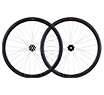
This is not a hypothetical problem. Industry designers are increasingly questioning the "stiffer is better" mantra. As noted in recent analyses of carbon wheel design, the pendulum may have swung too far: "the goal posts may be shifting" as manufacturers dial back extreme lateral rigidity to achieve better real-world performance. A bike that is too stiff can actually feel slower because it demands more effort to hold a line through unpredictable, high-frequency trail chatter.
Lateral Compliance vs. Vertical Compliance
To understand this, it helps to distinguish between two types of frame flex. Vertical compliance is the frame’s ability to absorb impacts and vibrations from trail bumps. It improves comfort and traction on rough ground. Lateral (or horizontal) compliance is the frame’s ability to twist slightly side‑to‑side under cornering loads.
While marketing has long focused on making frames both "laterally stiff and vertically compliant," the reality is more complex. Controlling the degree of lateral flex is an engineering art. A frame that exhibits controlled lateral compliance—essentially, a small amount of torsional twist—can help the rear wheel track the ground more faithfully through a corner, maintaining a larger contact patch and improving grip. The Rocky Mountain Instinct Carbon 70 AXS review noted that lateral flex "helped on my fast, local, hardpacked trails," and the bike “bends quite literally around corners,” flexing in a way that makes it “a scalpel on the trail.” This controlled flex is not a flaw; it is a feature that enhances handling precision.
How Carbon Fiber Allows Precise Tuning
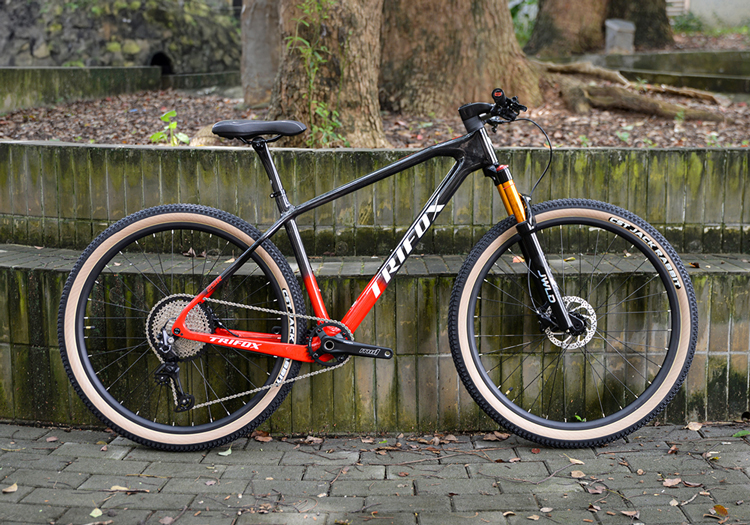
The advantage of a high-quality carbon frame like the SDY21 is the ability to tune stiffness in specific directions. Unlike aluminum, which has a more uniform stiffness profile, T800 carbon fiber allows engineers to orient the layup of carbon sheets to achieve a desired ride character. Through finite element analysis (FEA), designers model stresses across the frame and strategically place stiffer carbon in high-load zones while allowing a calculated degree of compliance in others.
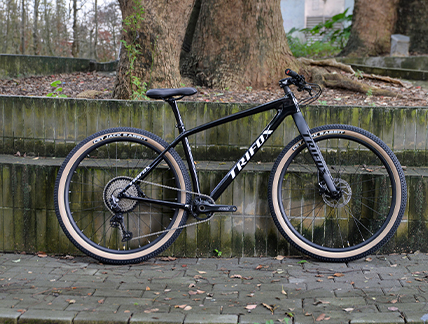
The SDY21 geometry also contributes to this balance. With a 70° head tube angle and 443mm chainstays, the bike is stable at speed yet agile enough for tight switchbacks. The short chainstays improve maneuverability, while the carbon layup in the rear triangle is tuned to track through corners without feeling harsh. This design prioritizes real‑world handling over raw acceleration.
The Rider Experience
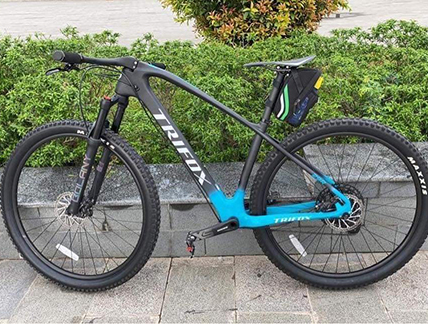
What does controlled lateral compliance feel like on the trail? Owners of the SDY21 consistently report that the bike “soaks up trail chatter” and “climbs like a dream,” yet feels “planted” on descents. One reviewer noted that it “just disappears under you”—the mark of a frame that works with the rider rather than fighting the terrain. Another praised it as “lightweight, agile, and very fun on the trail.”
This is the magic of a well-tuned carbon frame. You stop thinking about the bike and start focusing on the trail. The frame’s subtle forgiveness allows you to hold your line through loose sections, and its vibration damping lets you ride longer with less fatigue.
The Practical Bottom Line
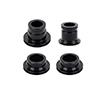
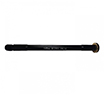
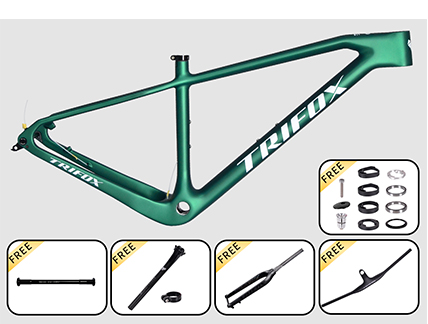
For riders considering an entry level hardtail mountain bike, the SDY21 represents an exceptionally compelling choice. It is a genuine cheap mountain bikes option that delivers premium features: a full T800 carbon frame weighing as little as 1,028 grams, full internal cable routing, and compatibility with three axle standards (135mm QR, 142mm TA, and 148mm Boost). But its real value lies in its ride quality—a balanced tuning of stiffness and compliance that proves you do not need to suffer a harsh ride to enjoy the benefits of carbon.
The next time you hear “stiffer is better,” remember that engineering excellence is about balance. A frame that bends just enough to hold traction, absorbs just enough chatter to keep you fresh, and reacts precisely when you need it to is not a compromise. It is a smarter design. The Trifox SDY21 is proof that sometimes, the best frames are the ones that give a little to gain a lot.
2026-04-27
Trifox
SHARE:


Comments
Recent Posts
1
1
1
1
1
1
1
1
1
1
1
1
1
1
1
1

1
1
1
1
1
1
1

1



