


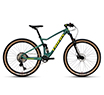
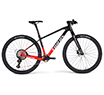
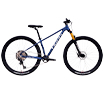

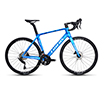
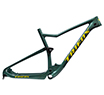
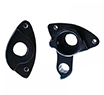
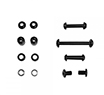
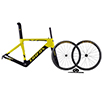
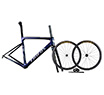
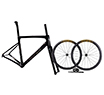
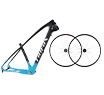
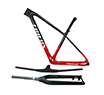
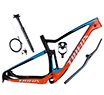
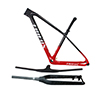





You have a budget in hand and a long list of components. The classic dilemma: should you invest first in the frame, or pour your money into a top‑tier rear shock? Choose wrong, and you risk wasted budget or a bike that never feels balanced. The answer is clearer than you might think: frame first, shock second. The frame is the foundation; the shock adds the finishing touch. Frame geometry defines the bike‘s character—XC efficiency, trail composure, or enduro aggression—while the shock simply needs to match that platform. If your budget allows a quality frame to start, the disc brake bike frame MFM100 is an excellent starting point, built with the engineering priorities that align with your riding goals.
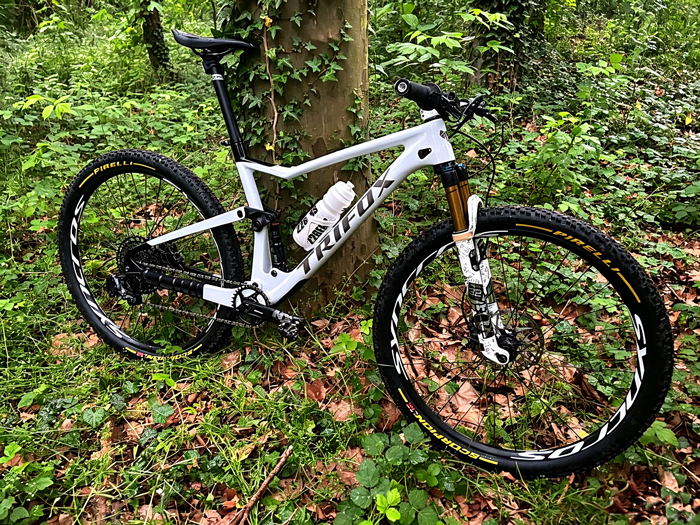
Why Frame First?
A rear shock is not a universal component. Its critical dimensions—eye‑to‑eye length and stroke—are dictated entirely by the frame. Choose a frame first, and you immediately know which shock sizes you need. Spec a shock before the frame and you risk incompatibility, wasted money, or a shock that simply won’t fit. The MFM100 simplifies this by defining clear shock parameters (165mm eye‑to‑eye, 40/45mm stroke), so you can focus on tuning rather than guesswork.
Air vs. Coil: The Decision After the Frame
Once the frame is locked in, choosing the rear shock becomes a focused decision. Air shocks are the standard for XC and light trail use. They are lightweight, tunable with a simple pump, and suit varied terrain. Coil shocks offer superior small‑bump sensitivity and traction, but add weight. With the MFM100’s efficient, climb‑oriented kinematics, an air shock is the recommended match for most riders—keeping weight low while preserving pedaling efficiency.
MFM100: A Smart Foundation
The MFM100 is a T800 carbon full‑suspension frame featuring Boost 148x12mm rear spacing, a threaded BSA bottom bracket, and a proven four‑bar linkage. For this frame, the recommended shock dimensions are 165mm eye‑to‑eye and 40mm or 45mm stroke. For XC and marathon use, consider a Rockshox SIDLuxe or Fox Float DPS. For more aggressive trail riding, the Fox Float X or Rockshox Super Deluxe provide additional support and control without overwhelming the frame‘s intended travel range.
Room for Taller Riders: The 19‑Inch Frame Option
The MFM100 is available in multiple sizes, including a 19 inch bike frame (size L). This larger geometry offers a roomy reach and taller stack, accommodating riders from 180–195cm. Choosing the correct size first ensures your future shock upgrades won’t be hindered by fitment issues—investing in the right frame size upfront saves costly adjustments later.
Smart Building Priorities: A Quick Checklist
1. Choose the frame that matches your terrain and fit (e.g., MFM100).
2. Confirm shock dimensions from the frame spec (165 x 40/45mm).
3. Select shock type (air for XC/trail, coil for heavier descending).
4. Check mounting hardware (bushings, bolts) to fit the frame.
5. Set sag and rebound based on rider weight and trail conditions.
By leading with the frame, you avoid compatibility traps and build a bike that performs as a cohesive system. The MFM100 provides a reliable, modern disc‑brake platform that makes the rest of your build straightforward. Start with the foundation—everything else will follow.
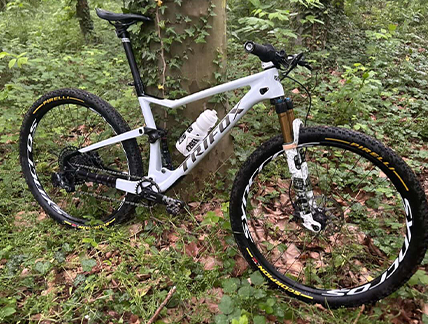
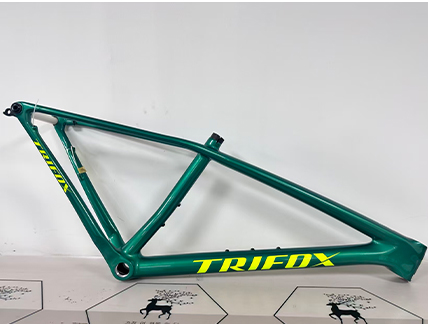
Trail chatter is the mountain biker’s silent enemy. The constant high-frequency vibration from roots, rocks, and rough ground doesn‘t just make your hands sore—it accelerates muscle fatigue, blurs your focus, and compounds over every mile. Many riders assume that only suspension can solve this. But the frame material itself plays a profound role. A carbon frame like the Trifox SDY20 17.5 bike frame (available in 15″, 17″, and 19″ sizes) transforms the ride experience not just through low weight, but through its unique ability to absorb trail vibration while maintaining pedaling efficiency. Here’s how modern carbon engineering achieves what metal simply cannot.
From Metal to Composite: A Fundamental Difference
Aluminum is a crystalline metal uniform in all directions. When vibration energy enters an aluminum frame, it transmits as a sharp, undampened shockwave directly to the rider. Steel is more compliant but heavier. Carbon fiber, however, is a composite. Thousands of individual fibers embedded in an epoxy resin matrix create a structure that can be engineered with different properties in different directions. This anisotropy is the key to carbon‘s vibration-damping advantage. The resin matrix acts as a microscopic damping agent. When high-frequency vibration enters the layup, energy is dissipated as heat within the resin and between fiber layers rather than being transmitted onward.
The Layup: Where Comfort Is Engineered
The magic of carbon isn‘t just the material—it’s how the material is arranged. A carbon frame is built from dozens of thin sheets (plies) of carbon fiber impregnated with resin, each laid at a specific orientation. By controlling the layup schedule—the number of layers, their orientation, and where they are placed—engineers can tune stiffness in one direction while allowing compliance in another. High-modulus fibers laid along the downtube and chainstays resist pedaling forces for crisp power transfer. Yet the same structure can allow controlled flex in the seatstays to absorb rear-wheel impacts, reducing shock transmitted to the rider before it reaches the spine. One study found that carbon fiber‘s damping properties enable road‑shock absorption efficiency of up to 92%, with comfort improvements of 41% on rough sections compared to less-engineered alternatives.
Carbon vs. Aluminum: The Ride Feel Difference
Aluminum offers excellent stiffness and affordability, but it doesn‘t absorb vibration as effectively, which can result in a harsher ride. Aluminum transmits “trail buzz” directly, leaving your hands and arms to absorb the punishment. This leads to faster fatigue and more difficult line-holding on loose terrain. Carbon’s natural damping filters out high-frequency vibrations, keeping you fresher and more in control. The Trifox SDY20, built with T800 carbon, exemplifies this balance. T800 occupies a sweet spot between entry-level T700 and ultra-stiff premium fibers, offering excellent stiffness for pedaling efficiency while retaining enough vertical compliance for real‑world comfort.
What T800 Brings to the Trail
T800 carbon has a higher tensile modulus (stiffer) than T700, allowing frame designers to use less material to achieve the same stiffness—or build a stiffer frame at the same weight. This translates to immediate power transfer and responsive handling when accelerating or climbing. More importantly for trail riders, T800‘s balance means you don’t sacrifice comfort for performance. The material is neither so flexy as to feel vague nor so rigid as to be harsh. Professional analysis confirms that T800 often provides a better balance of stiffness and vertical compliance than higher-modulus fibers like T1000. For riders seeking a 17.5 bike frame that climbs efficiently yet stays comfortable over long days, this precise blend of properties makes a tangible difference. Not all T800 is equal—quality control in fiber layup and resin application is critical—and Trifox‘s attention to this detail ensures the SDY20’s layup delivers consistent, predictable damping.
Making It Yours: Custom Frame Painting
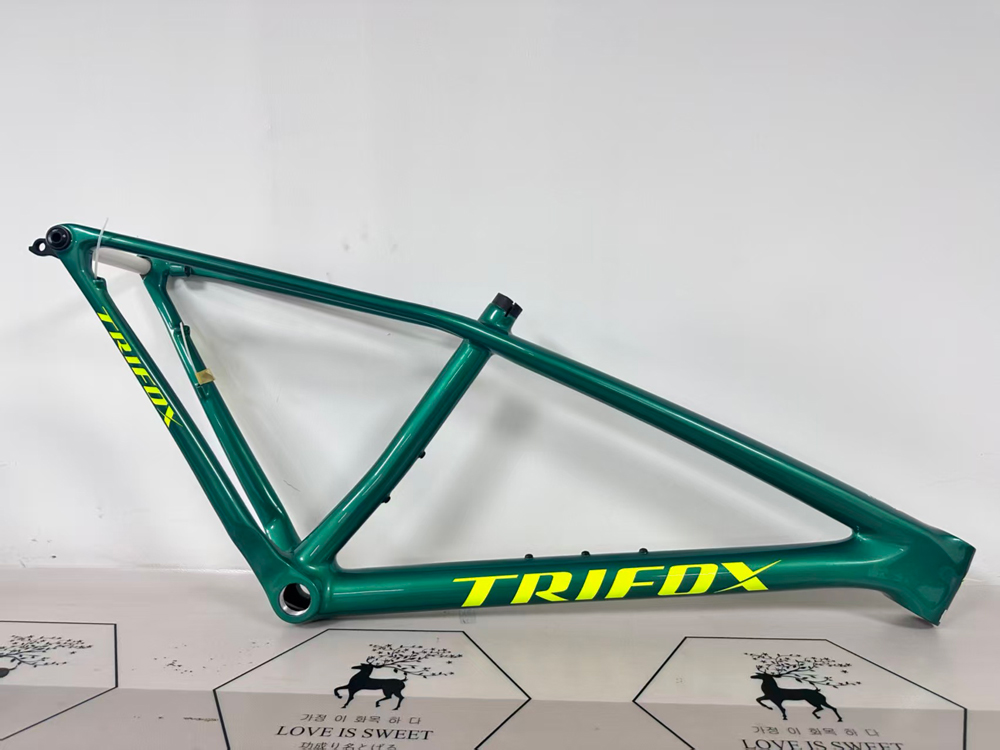
A carbon frame‘s performance core is the same whether it wears subtle livery or bold colors. But personalization matters. Trifox offers custom bicycle frame painting options, allowing you to choose from multiple colors (the SDY20 is available in finishes such as Red, Green, and Glossy black). Whether finishing a stealth race build or a standout trail bike, custom paint doesn’t affect the engineering—it reflects your identity without compromising the frame‘s vibration-damping layup.
The Long‑Ride Payoff
Over hours in the saddle, vibration isn’t a minor inconvenience—it‘s a performance limiter. Carbon’s ability to reduce transmitted vibration means less muscle tension, clearer vision, and better bike control, especially in technical sections where staying loose matters. The rigid front triangle keeps steering precise, while the rear stays can be tuned to absorb just enough chatter to keep the rear wheel planted. That‘s the real magic of a well-engineered carbon frame: you stop thinking about the bike and start flowing with the trail. The Trifox SDY20 proves that carbon’s advantage isn‘t just about grams on a scale—it’s about how the material makes you feel on mile 30, mile 50, and beyond.
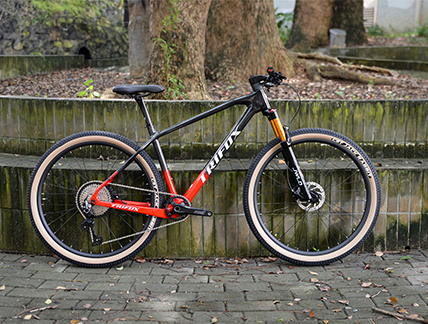
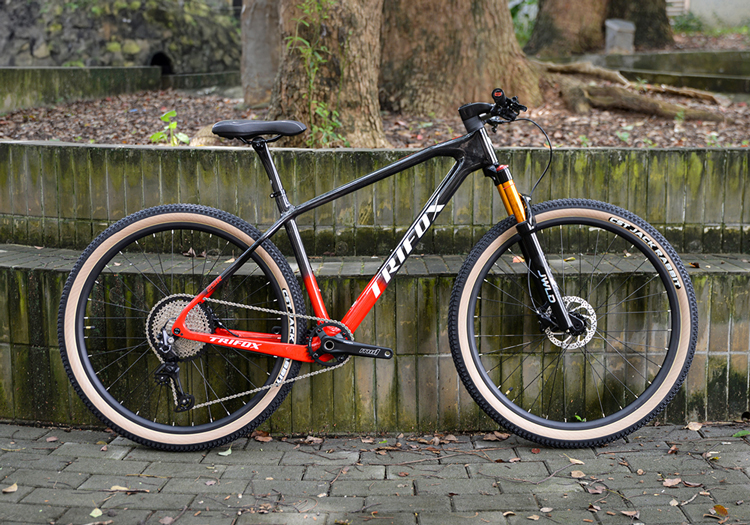
The mountain biking industry has long sold us on a simple message: stiffer is better. Stiffer frames, stiffer wheels, stiffer cockpits. The logic seems impeccable—less flex means more power transfer, more precise steering, and a bike that goes exactly where you point it. But like many simple truths, this one overlooks a crucial nuance. Real-world trails are not smooth, predictable tracks. They are chaotic tapestries of roots, rocks, off-camber turns, and sliding loam. On such terrain, an extremely stiff bike can actually hold you back. A frame with just the right amount of lateral compliance—controlled side-to-side flex—can improve traction, enhance cornering confidence, and reduce fatigue, transforming a good hardtail into a great one. The Trifox SDY21 carbon hardtail embodies this balanced philosophy, proving that sometimes, a little bit of give is exactly what you need.
The Problem with Total Rigidity
An ultra-stiff frame resists flex in all directions. On smooth pavement, this is ideal. On a rough trail, however, a supremely rigid rear end fights the terrain's natural irregularities. When you lean into a loose corner, an overly stiff frame can feel skittish, breaking traction rather than conforming to the surface. Worse, it transfers every vibration and shock directly to the rider, accelerating hand, arm, and back fatigue.
This is not a hypothetical problem. Industry designers are increasingly questioning the "stiffer is better" mantra. As noted in recent analyses of carbon wheel design, the pendulum may have swung too far: "the goal posts may be shifting" as manufacturers dial back extreme lateral rigidity to achieve better real-world performance. A bike that is too stiff can actually feel slower because it demands more effort to hold a line through unpredictable, high-frequency trail chatter.
Lateral Compliance vs. Vertical Compliance
To understand this, it helps to distinguish between two types of frame flex. Vertical compliance is the frame’s ability to absorb impacts and vibrations from trail bumps. It improves comfort and traction on rough ground. Lateral (or horizontal) compliance is the frame’s ability to twist slightly side‑to‑side under cornering loads.
While marketing has long focused on making frames both "laterally stiff and vertically compliant," the reality is more complex. Controlling the degree of lateral flex is an engineering art. A frame that exhibits controlled lateral compliance—essentially, a small amount of torsional twist—can help the rear wheel track the ground more faithfully through a corner, maintaining a larger contact patch and improving grip. The Rocky Mountain Instinct Carbon 70 AXS review noted that lateral flex "helped on my fast, local, hardpacked trails," and the bike “bends quite literally around corners,” flexing in a way that makes it “a scalpel on the trail.” This controlled flex is not a flaw; it is a feature that enhances handling precision.
How Carbon Fiber Allows Precise Tuning
The advantage of a high-quality carbon frame like the SDY21 is the ability to tune stiffness in specific directions. Unlike aluminum, which has a more uniform stiffness profile, T800 carbon fiber allows engineers to orient the layup of carbon sheets to achieve a desired ride character. Through finite element analysis (FEA), designers model stresses across the frame and strategically place stiffer carbon in high-load zones while allowing a calculated degree of compliance in others.
The SDY21 geometry also contributes to this balance. With a 70° head tube angle and 443mm chainstays, the bike is stable at speed yet agile enough for tight switchbacks. The short chainstays improve maneuverability, while the carbon layup in the rear triangle is tuned to track through corners without feeling harsh. This design prioritizes real‑world handling over raw acceleration.
The Rider Experience
What does controlled lateral compliance feel like on the trail? Owners of the SDY21 consistently report that the bike “soaks up trail chatter” and “climbs like a dream,” yet feels “planted” on descents. One reviewer noted that it “just disappears under you”—the mark of a frame that works with the rider rather than fighting the terrain. Another praised it as “lightweight, agile, and very fun on the trail.”
This is the magic of a well-tuned carbon frame. You stop thinking about the bike and start focusing on the trail. The frame’s subtle forgiveness allows you to hold your line through loose sections, and its vibration damping lets you ride longer with less fatigue.
The Practical Bottom Line
For riders considering an entry level hardtail mountain bike, the SDY21 represents an exceptionally compelling choice. It is a genuine cheap mountain bikes option that delivers premium features: a full T800 carbon frame weighing as little as 1,028 grams, full internal cable routing, and compatibility with three axle standards (135mm QR, 142mm TA, and 148mm Boost). But its real value lies in its ride quality—a balanced tuning of stiffness and compliance that proves you do not need to suffer a harsh ride to enjoy the benefits of carbon.
The next time you hear “stiffer is better,” remember that engineering excellence is about balance. A frame that bends just enough to hold traction, absorbs just enough chatter to keep you fresh, and reacts precisely when you need it to is not a compromise. It is a smarter design. The Trifox SDY21 is proof that sometimes, the best frames are the ones that give a little to gain a lot.
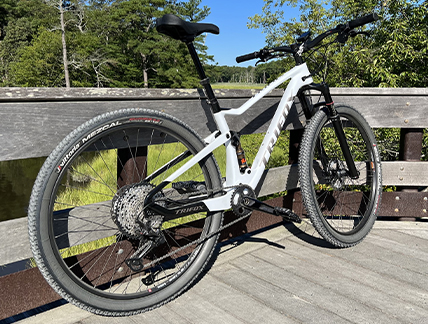
A full-suspension mountain bike lives or dies by its rear suspension. The right design transforms a rough trail into a flowing ribbon of traction and control. The wrong one leaves you fighting pedal bob, brake jack, and a rear wheel that refuses to track. The Trifox MFM100 carbon full-suspension frame is engineered around a four-bar linkage system with a Trunnion-mounted rear shock—a combination that prioritizes climbing efficiency, descending composure, and long-term reliability. Here's how this suspension design works and why it makes the MFM100 an outstanding mtb trail bike frame for XC and light trail riding.
Four-Bar Linkage: The Science of Predictable Traction
The MFM100 employs a Horst-link-style four-bar linkage, a design proven over decades of mountain bike development. Unlike a simple single-pivot system, a four-bar linkage uses a series of linkages to create a virtual pivot point—a floating center of rotation that can be positioned anywhere the designer chooses. This unlocks two critical benefits for trail performance.
Anti-Squat and Pedaling Efficiency: Anti-squat measures how much the suspension resists compressing under pedaling forces. Too little anti-squat, and the bike bobs excessively on climbs. Too much, and the suspension becomes harsh and unresponsive. With a four-bar linkage, the designer can tune the anti-squat curve to be maximally effective right at the sag point—where the bike sits most of the time—while relaxing it deeper in the travel. The result is a frame that climbs with the urgency of a hardtail but remains active and plush over roots and rocks.
Anti-Rise and Braking Stability: Anti-rise describes how braking forces affect suspension compression. When you grab the brakes on a steep descent, some designs cause the rear suspension to stiffen (high anti-rise), reducing traction and control. The four-bar layout of the MFM100 reduces the effect of braking forces on the suspension, meaning the rear wheel stays active and glued to the trail even when you're on the anchors.
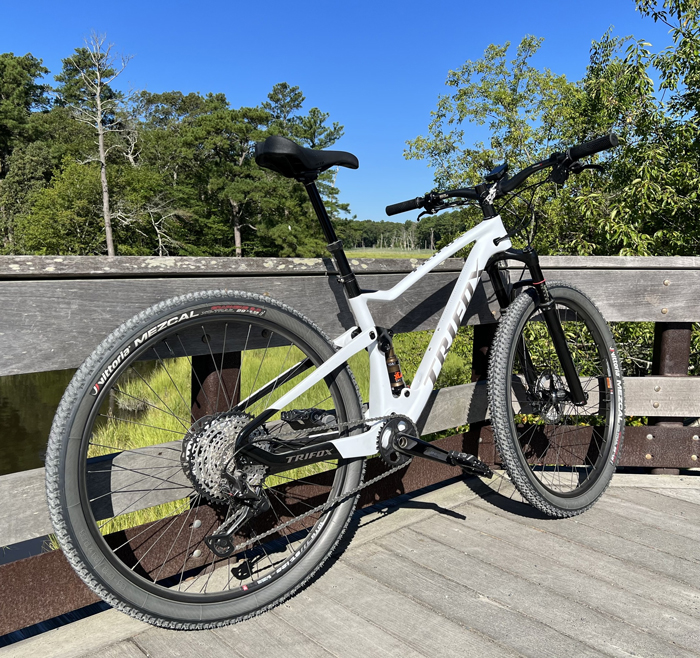
For riders pushing hard on technical descents, this predictable, unflappable rear-end behavior is what separates a confidence-inspiring mtb trail bike frame from one that keeps you guessing. Independent reviews confirm that the MFM100 tracks straight on steep, rocky runs, with the carbon frame staying composed under hard hits.
Trunnion Mount: A Compact, Efficient Shock Interface
The MFM100 features a Trunnion rear shock mount, a design that has rapidly become the standard on modern performance frames. Instead of the traditional eyelet-and-bolt attachment at both ends, a Trunnion mount secures the shock at two points on the frame. This design choice delivers several tangible benefits.
Improved Suspension Performance: The Trunnion mount allows the shock to pivot more freely around its mounting points, producing a smoother, more linear suspension curve. The shock compresses and extends with less friction, translating to better traction and control on uneven surfaces.
Reduced Weight and Enhanced Geometry: By eliminating the need for long eyelets and reducing the overall length of the shock, the Trunnion mount contributes to a lighter overall frameset. It also allows frame designers to optimize bike geometry and create better clearance for larger tires. On the MFM100, this translates to generous tire clearance up to 29×2.35 inches, giving you the freedom to run high-volume rubber for comfort and traction.
T800 Carbon: Stiff, Light, and Composed
All this sophisticated suspension hardware is wrapped in a T800 carbon fiber frameset. T800 is a high-modulus carbon fiber known for its excellent stiffness-to-weight ratio. The result is a frame that weighs just 2170–2420 grams depending on size (XS to L)—remarkably light for a full-suspension chassis. More importantly, the carbon construction provides the lateral stiffness needed to keep the bike tracking precisely through corners and under power.
Riders who have built up the MFM100 consistently praise its rigidity. One owner noted that the frame is "very fast and rigid," with pedaling force transmitting directly to the wheels without wasteful flex. On the descents, the carbon frame stays composed and planted, never feeling nervous or twitchy.
Versatility: From Geared Trail Bike to Single Speed
The MFM100's T800 carbon frame and threaded BSA 68mm bottom bracket provide an exceptionally versatile platform. While it's designed for geared 1× drivetrains, its solid rear triangle and robust pivot construction also make it a surprisingly capable candidate for a single speed bike frame build.
Converting a full-suspension frame to single speed requires a chain tensioner mounted to the derailleur hanger (the MFM100 uses a replaceable hanger). The bike's four-bar linkage exhibits minimal chain growth through its travel, which keeps the chain tension stable and reduces the risk of drivetrain binding or chain snap—a common issue when converting less sophisticated suspension designs to single speed. For riders seeking an ultra-low-maintenance, quiet, and mechanically pure trail experience, the MFM100 offers a compelling single-speed platform.
Trail-Ready Geometry and Modern Standards
The MFM100's geometry is tuned for modern XC and trail riding. A 68.5° head tube angle provides stability at speed without sacrificing front-end traction on climbs. The 74.7° seat tube angle places the rider in a powerful, centered pedaling position. Boost 148×12mm rear spacing increases wheel stiffness and allows for shorter chainstays, enhancing agility. Internal cable routing keeps the frame clean and protects hoses from trail debris.
Conclusion
The Trifox MFM100 carbon full-suspension frame delivers a suspension system that punches well above its price class. The four-bar linkage provides tunable anti-squat for efficient climbing and reduced anti-rise for confident braking. The Trunnion-mounted rear shock ensures smooth, linear suspension action while saving weight and improving geometry. And the T800 carbon construction offers the stiffness and light weight that serious riders demand. Whether you're building a dedicated XC race machine, a versatile mtb trail bike frame, or even a minimalist single speed bike frame, the MFM100 is a platform that handles the trail with composure and confidence.
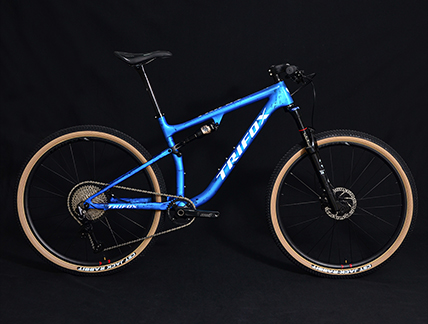
When you’re racing cross-country or pushing through a wet, rooty trail, tire clearance isn’t just a spec—it’s a performance limiter. A frame that packs up with mud can turn a fast bike into a heavy, sluggish mess. The Trifox TRAIL II PRO is a xc full suspension bike frames designed for modern XC and trail riding, with a stated maximum tire size of 29 x 2.25″. But does it actually have room to breathe when the trail turns sloppy? And could this frame even work as a single speed 29er frame for a stripped-down, efficient build? Let’s dig into the real-world clearance and versatility of this carbon full-suspension chassis.
The Official Spec: 2.25″ – But What About 2.3″?
According to the manufacturer, the TRAIL II PRO officially clears tires up to 29 x 2.25″. This is a common width for modern XC and light trail tires, offering a balance of low rolling resistance and enough volume for comfort and traction. However, several riders have reported that in clean, dry conditions, the frame can accommodate a 2.3″ tire without rubbing. The extra 0.05″ (about 1.3mm) of width is often possible thanks to the frame’s generous chainstay and seatstay shaping. But the key word is “clean.” When mud, clay, or sticky loam accumulates, that 2.3″ tire may start contacting the frame, especially near the seat tube bridge or the chainstay yoke.
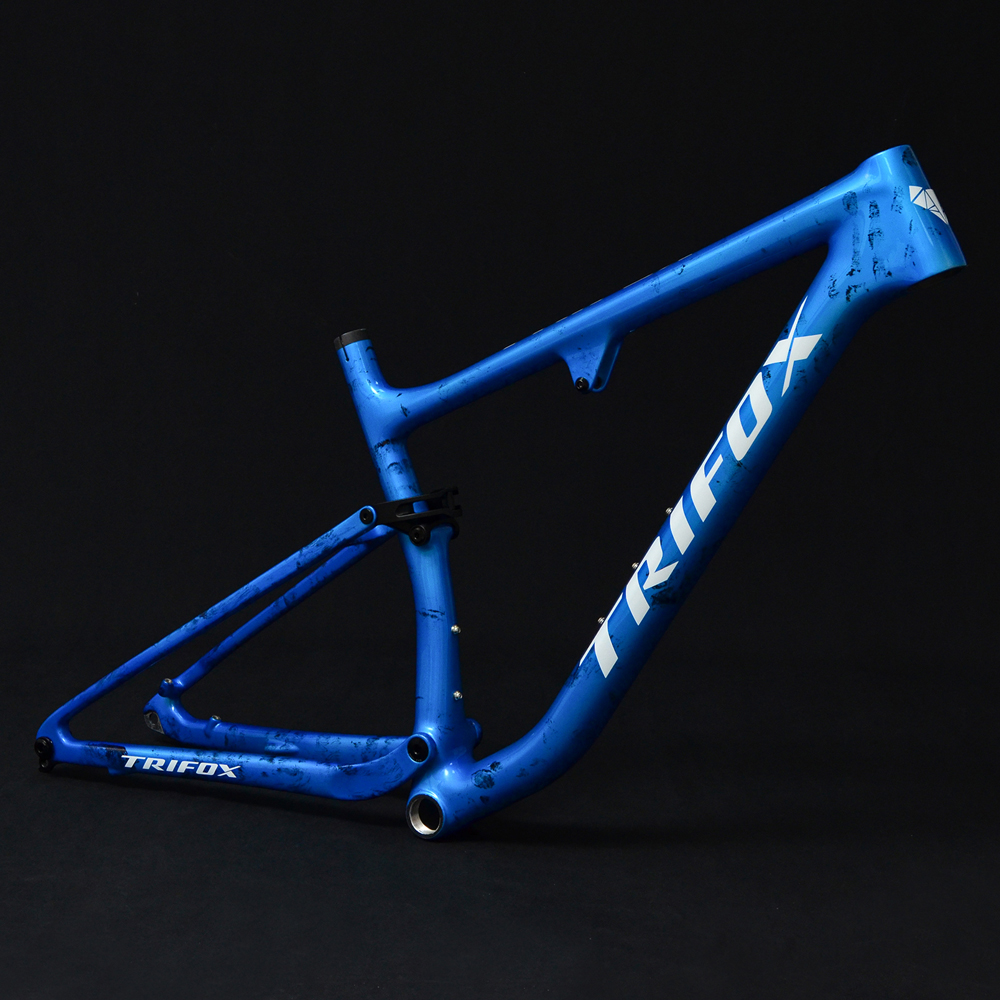
Mud Clearance: The Real Test
The TRAIL II PRO features a relatively wide chainstay bridge and a sculpted seat tube to provide clearance behind the tire. The horizontal clearance between the tire and the seat tube is adequate for most race-day mud, but heavy, claggy conditions will still require caution. The rear triangle’s UDH dropout and thru-axle design keep the wheel precisely aligned, which helps maintain consistent clearance. For riders who regularly encounter wet, muddy conditions, sticking to the official 2.25″ maximum is wise. For dry, dusty trails or summer racing, a 2.3″ tire can be a nice volume boost without issue.
Why Clearance Matters for XC Full Suspension Frames
For xc full suspension bike frames, tire clearance directly affects traction, comfort, and line choice. A slightly wider tire at lower pressure can smooth out root sections and improve cornering grip without adding significant weight. The TRAIL II PRO’s ability to accept a 2.25″ (or even a light 2.3″) tire makes it more versatile than older XC frames that were limited to 2.1″ or 2.2″. This opens up the bike for marathon events, technical XC courses, and even light trail riding.
Could It Work as a Single Speed 29er Frame?
The TRAIL II PRO features a Universal Derailleur Hanger (UDH) and a replaceable dropout system. While it’s designed for geared drivetrains, the UDH interface can be adapted for single-speed use with an eccentric bottom bracket, a chain tensioner, or by using a single-speed-specific hub with horizontal-ish dropouts (though the frame uses thru-axle dropouts). More commonly, riders convert full-suspension frames to single speed by using a chain tensioner mounted to the derailleur hanger. The TRAIL II PRO’s suspension design (190mm eye-to-eye shock, 35-45mm travel) is efficient enough for a stripped-down, lightweight single speed 29er frame build, especially for flowy XC trails or bike packing. However, the frame’s primary intent remains geared XC racing.
Frame Design Details That Help
- Asymmetric chainstays: Provide extra clearance on the drive side for wider tires.
- Boost 148x12mm spacing: Creates a stiffer rear end, which also helps maintain consistent tire clearance under load.
- Internal cable routing: Keeps hoses out of the way, reducing mud traps.
- Threaded BB68 bottom bracket: Easy to service and compatible with single-speed cranksets.
Real-World Rider Feedback
Reviews from owners mention that the TRAIL II PRO feels planted and stiff, and several have successfully mounted 2.3″ tires for dry conditions. One reviewer noted, “There is 74mm between the chainstays, so we will try to run Rick XC 2.4 tires.” That suggests even more room than advertised, but always test-fit before relying on a tight clearance. For mud, most agree that sticking to 2.25″ is the safe bet.
Conclusion
The Trifox TRAIL II PRO is a well-engineered xc full suspension bike frames that offers genuine clearance for 2.25″ tires and, in dry conditions, even 2.3″. Its mud clearance is adequate for race-day slop but not designed for deep, sticky clay. For riders who want a versatile, lightweight full-suspension frame that can also be adapted into a minimalist single speed 29er frame, the TRAIL II PRO provides a solid platform. Just match your tire choice to the conditions, and you’ll have room to breathe—and to ride fast.
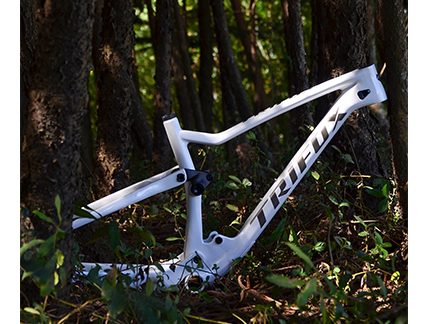
There’s a moment on every climb—the pitch steepens, the trail turns to loose rock, and gravity starts winning. Your legs burn, your lungs scream, and the bike feels like it’s fighting you. Now imagine that same climb, but the bike feels eager, responsive, and almost playful. That’s the difference a lightweight carbon frame can make. The Trifox MFM100 full suspension frame, built from high-modulus T800 carbon fiber, transforms the uphill experience, allowing you to climb faster, conserve energy, and ultimately ride longer.
Why Weight Matters Most on the Climb
Physics is simple: moving less mass uphill requires less energy. Every gram saved on a frame is a gram you don’t have to haul to the top. But the MFM100’s weight advantage goes beyond the number on a scale. Its T800 carbon fiber construction allows for a remarkably low frameset weight—starting at just 2170g for the XS size, including hardware. This weight savings is concentrated at the heart of the bike, improving the bike’s power-to-weight ratio where it matters most: when you’re out of the saddle, grinding up a steep grade.
More importantly, weight loss at the frame contributes to a better overall system efficiency. A lighter bike accelerates faster out of corners, requires less effort to maintain momentum on rolling terrain, and feels less punishing when you need to carry speed over short, punchy climbs. For riders seeking a small full suspension mountain bike frame, the MFM100’s low weight in the XS and S sizes (fitted with 27.5” wheels) offers an even more pronounced advantage, making the bike feel nimble and flickable on technical climbs.
Efficiency Through Stiffness and Suspension Design
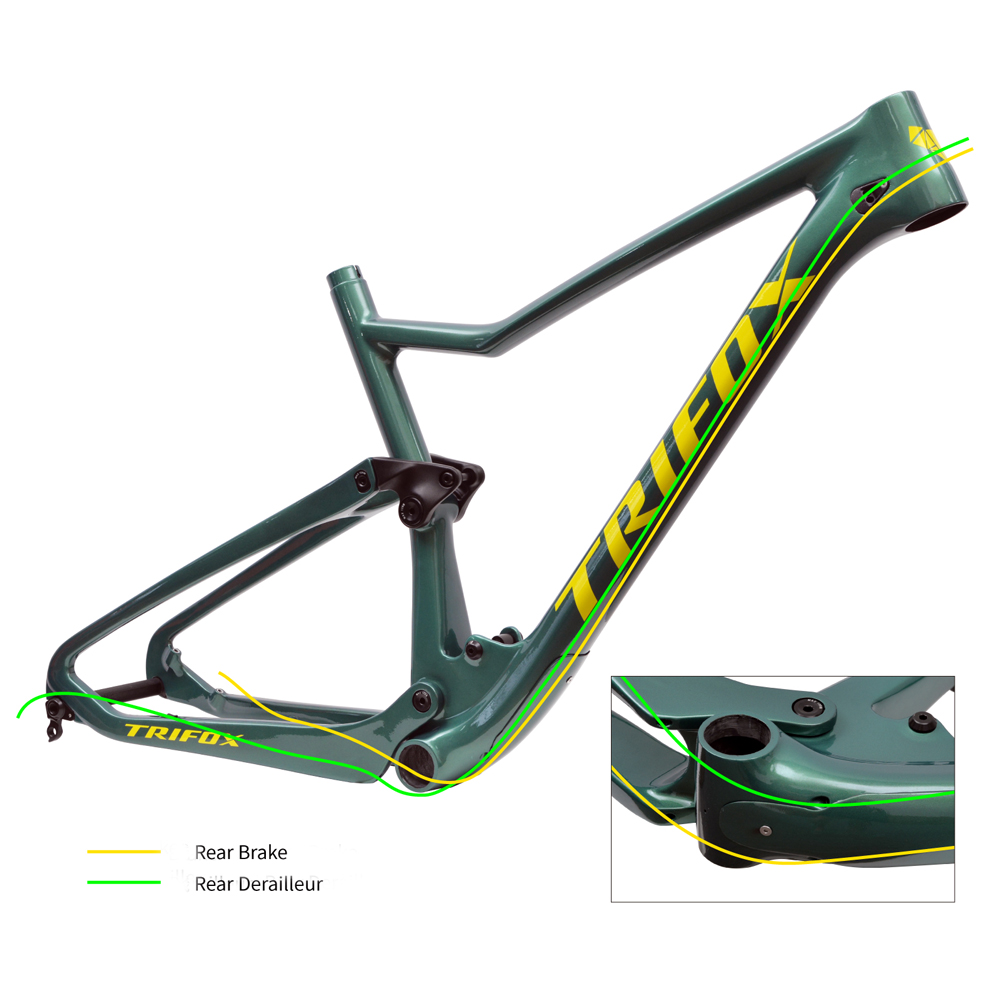
Light weight alone isn’t enough. A climbing bike must also convert your energy efficiently into forward motion. The MFM100’s carbon layup is engineered for exceptional pedaling stiffness, particularly in the bottom bracket and chainstay area. This means less of your power is wasted flexing the frame. The suspension kinematics are equally critical. The Trunnion-mounted rear shock and Boost 148mm rear axle work together to create a platform that minimizes pedal-induced bob while remaining active enough to maintain traction on loose or uneven surfaces. The result is a bike that climbs with the urgency of a hardtail but offers the rear-wheel grip of a full-suspension machine.
More Energy for the Descent
The real reward of a lightweight frame isn’t just a faster climb time; it’s the energy you save for the rest of the ride. By requiring less effort to ascend, you arrive at the summit with fresher legs, a clearer mind, and more reserves to enjoy the descent. On a long backcountry loop or an all-day trail adventure, this cumulative energy savings translates directly into riding longer, with greater control and less fatigue. For taller riders, the carbon fiber 29er frame in sizes M and L offers the same efficiency benefits, ensuring that even larger-wheeled bikes don’t feel sluggish on the way up.
A Versatile Platform for Every Rider
The MFM100 is available in four sizes—XS, S, M, and L—with a geometry that balances aggressive XC efficiency with modern trail stability. Its 68.5° head tube angle and 74.7° seat tube angle place the rider in a powerful, centered position for climbing, while the 438mm chainstays provide stability and traction. Clearance for up to 29x2.35” tires means you can run high-volume rubber for comfort and grip without adding unnecessary rotational weight.
Ultimately, the Trifox MFM100 demonstrates that a full suspension carbon frame can be both a climbing weapon and a descending ally. Its lightweight T800 carbon construction, efficient suspension design, and modern geometry work in harmony to help you climb faster, conserve energy, and ride longer. Whether you’re chasing PRs or simply want to enjoy more trail with less fatigue, this frame delivers a real-world benefit that transforms every ride.
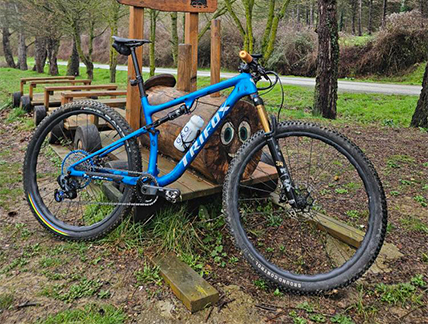
In the pursuit of a high-performance mountain bike, the frame is the ultimate foundation. It dictates not only the ride quality but also your ability to upgrade and maintain the bike with the latest components. The Trifox TRAIL II PRO carbon fiber 29er frame is engineered with a clear focus on modern, durable, and versatile standards. Its commitment to three key specifications—the Universal Derailleur Hanger (UDH), Boost 148 spacing, and the threaded BB68 bottom bracket—ensures it delivers peak performance today and remains adaptable for years to come.
UDH: Universal Protection and Next-Gen Readiness
The TRAIL II PRO features a Universal Derailleur Hanger (UDH), a seemingly small component that represents a massive step forward. This standardized hanger, developed by SRAM, is rapidly becoming the industry norm. Its presence on this frame offers two monumental advantages. First, it provides total compatibility with SRAM's latest direct-mount Transmission drivetrains, which require the UDH interface. This means your frame is ready for the cutting edge of drivetrain technology. Second, the UDH is engineered to be a sacrificial component. In a crash, it's designed to break in a controlled manner, absorbing impact forces and protecting the far more expensive derailleur and the frame's dropouts. Replacement is simple and the hangers are widely available—a true peace-of-mind feature for any rider.
Boost 148: The Stiffness and Strength Standard
Modern trail and XC riding demands a stiff and durable rear end. The TRAIL II PRO is built around the Boost 148x12mm axle standard. This wider hub spacing (148mm compared to the older 142mm) allows the hub flanges to be positioned further apart. This simple geometry change results in a stiffer, stronger rear wheel when paired with a Boost-compatible hub. A stiffer wheel tracks more accurately, corners with greater precision, and resists flex under hard pedaling and braking. Boost also enables frame designers to optimize chainstay length, as seen in the TRAIL II PRO's balanced 437mm stays, for improved traction without sacrificing agility.
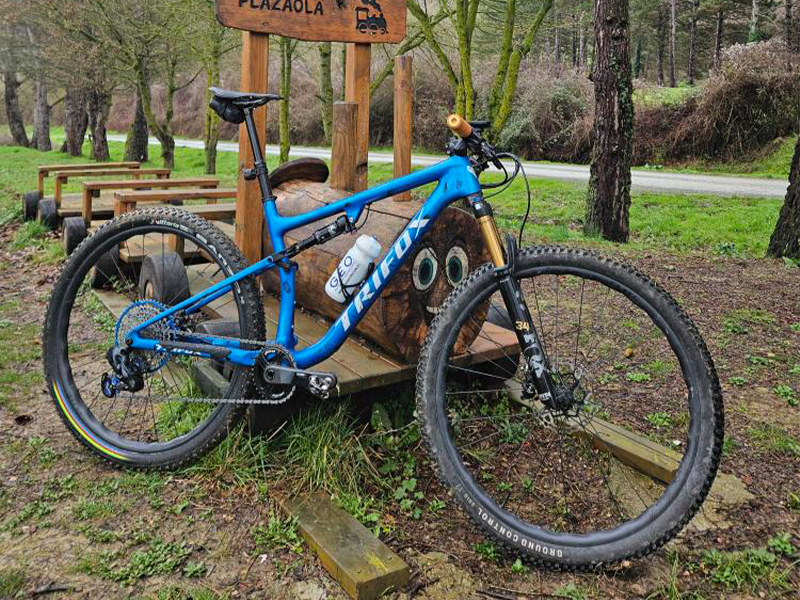
BB68: The Reliability of Threaded Simplicity
At the heart of the frame lies a BB68 threaded bottom bracket shell (BSA standard). In an era where press-fit bottom brackets are common, Trifox's choice of a threaded interface is a deliberate nod to long-term reliability and ease of maintenance. A threaded BB, like the BB68, is simply creak-proof compared to press-fit designs. Installation is straightforward with standard tools, and it provides a solid, immovable platform for your crankset. This ensures maximum power transfer and eliminates the annoying creaks that can plague press-fit shells over time. For a best chinese bike frame, this focus on a reliable, serviceable standard is a hallmark of thoughtful engineering.
A Lightweight, High-Performance Package
Beyond these modern standards, the TRAIL II PRO is a meticulously crafted T800 carbon fiber frameset. In the popular 17 inch bike frame size, it weighs an impressive 1680g (±20g) complete with hardware. Its geometry—a 67.5° head tube angle and 74.5° seat tube angle—is tuned for aggressive XC and trail riding, offering stability on descents while remaining efficient on climbs. With internal cable routing, clearance for 29x2.25" tires, and compatibility with 160/180mm rotors, it's a complete, modern platform.
Ultimately, the TRAIL II PRO's commitment to UDH, Boost, and BB68 is a commitment to you, the rider. It means choosing a carbon fiber 29er frame that isn't just light and stiff, but also intelligently designed to work with the best components available now and in the future. For riders seeking a durable, high-performance, and future-proof foundation, this frame represents an outstanding choice.
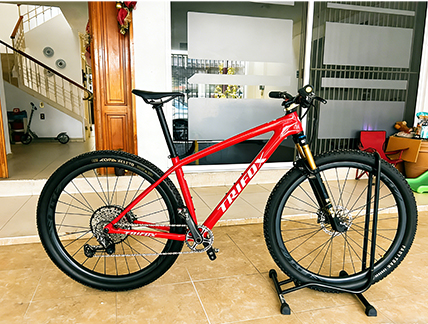
The mountain bike world is constantly evolving, and few recent advancements have been as significant as the arrival of SRAM's direct-mount Transmission drivetrain. This new standard promises unmatched durability and shift performance, but it requires a specific frame interface to function. For riders eyeing a future-proof build, the question is critical: Is your frame ready? The Trifox SDY20 carbon fiber mountain bike frame is designed with this next-generation compatibility front and center, ensuring it can accept the latest drivetrains while delivering exceptional lightweight performance.
The Three Pillars of Transmission Compatibility
SRAM's Eagle Transmission system, often referred to as T-Type, moves away from the traditional derailleur hanger. Instead, the derailleur bolts directly to a new, reinforced interface on the frame. This requires three key frame features, all of which the SDY20 possesses:
1. Universal Derailleur Hanger (UDH): The foundation of the system. The SDY20 features a UDH hanger, the standardized interface that is mandatory for Transmission. This ensures the derailleur mounts securely and aligns perfectly with the cassette.
2. Boost 148mm Spacing: Transmission derailleurs are designed for Boost hub spacing (148x12mm). The SDY20's Boost dropout provides the necessary width and stiffness for the direct-mount interface.
3. Chainline and Clearance: The frame's geometry, with its 430mm chainstays and clearance for up to 29x2.4" tires, accommodates the wider chainline and cassette of a Transmission setup without interference.
Beyond Compatibility: A Performance-First Design
Equipping the SDY20 with Transmission readiness is about more than just checking boxes. It's about building a frame that can fully leverage the performance benefits of this advanced drivetrain. The direct-mount interface eliminates a potential flex point, and when paired with the SDY20's inherently stiff T1000 carbon fiber construction, the result is a remarkably rigid rear end. This translates every watt of pedal input directly into forward thrust, with zero energy wasted in drivetrain or frame deflection. Whether you're sprinting out of a corner or mashing up a steep climb on a mountain bike 17.5 frame (size M), the power delivery feels immediate and precise.
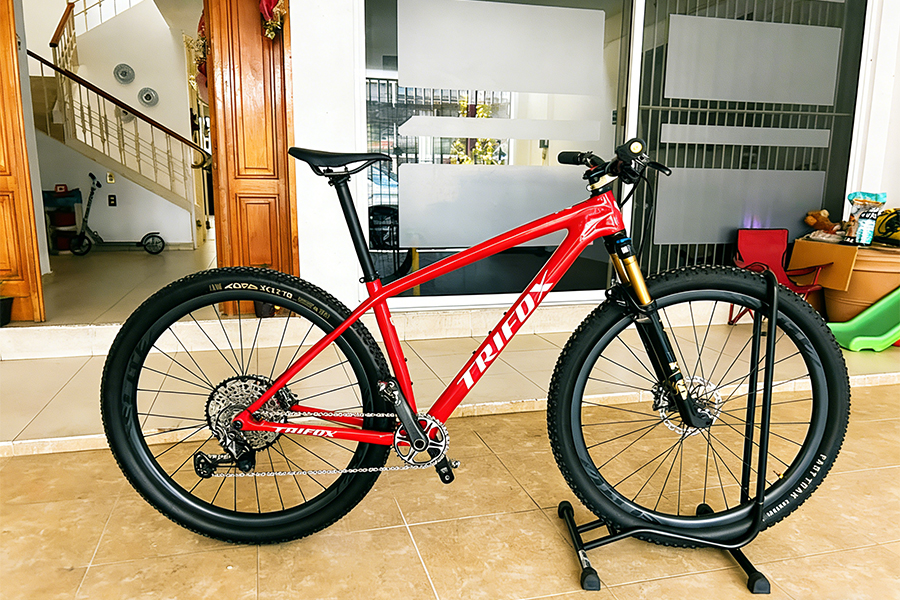
Lightweight Foundation for a Modern Build
Despite its rugged capabilities and future-proofed design, the SDY20 remains astonishingly light. The frame weight for a size mountain bike 17.5 frame (size M) is just 990g (±30g). This places it among the lightest hardtail frames available, making it an exceptional foundation for building a high-performance, modern XC or trail bike. Its 68.5° head tube angle and 74° seat tube angle provide a balanced, confident geometry that climbs efficiently and descends with stability—the perfect character for a bike built around a Transmission groupset.
In essence, the Trifox SDY20 isn't just a carbon fiber mountain bike frame for sale; it's a thoughtfully engineered platform that bridges the gap between today's performance and tomorrow's technology. By incorporating the UDH hanger, Boost spacing, and a stiff, lightweight chassis, it stands ready to accept SRAM's latest innovation. For the discerning builder who wants their hardtail to remain at the cutting edge for years to come, the SDY20 is a compelling and future-ready choice.
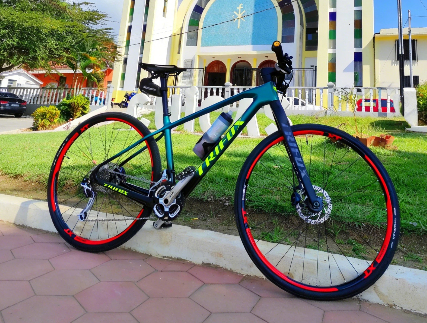
In the world of mountain biking, few things are as critical—or as potentially confusing—as frame compatibility. Wheel and axle standards have evolved significantly, leaving riders to choose between the modern stiffness of Boost, the widespread familiarity of Quick Release (QR), or the security of Thru-Axle (TA). The Trifox SDY21 carbon hardtail frame offers a refreshingly straightforward solution to this dilemma. It is available in three distinct models, each built for a specific O.L.D (Over Locknut Distance) standard, allowing you to select the exact version that matches your wheelset and riding preferences from the start.
Three Distinct Options for a Perfect Fit
Unlike frames that attempt to use adapters or interchangeable dropouts (which can introduce complexity or potential reliability issues), the SDY21 is manufactured as three separate, purpose-built frames. When you purchase, you simply select the version that matches your needs:
* 135mm Quick Release (QR): The traditional standard, perfect for compatibility with a vast range of entry-level and classic wheelsets. It offers simplicity and ease of use.
* 142x12mm Thru-Axle (TA): The evolution of the QR, providing a stiffer, more secure wheel-to-frame interface that improves handling and braking precision. This was the modern standard before Boost.
* 148x12mm Boost Thru-Axle (TA): The current industry gold standard. Boost spacing widens the hub flanges, creating a stiffer, stronger rear wheel and allowing for shorter chainstays, which improves traction and overall bike agility.
This approach means the rigid frame mtb you choose is perfectly engineered for its intended axle system from the factory, with no compromises.
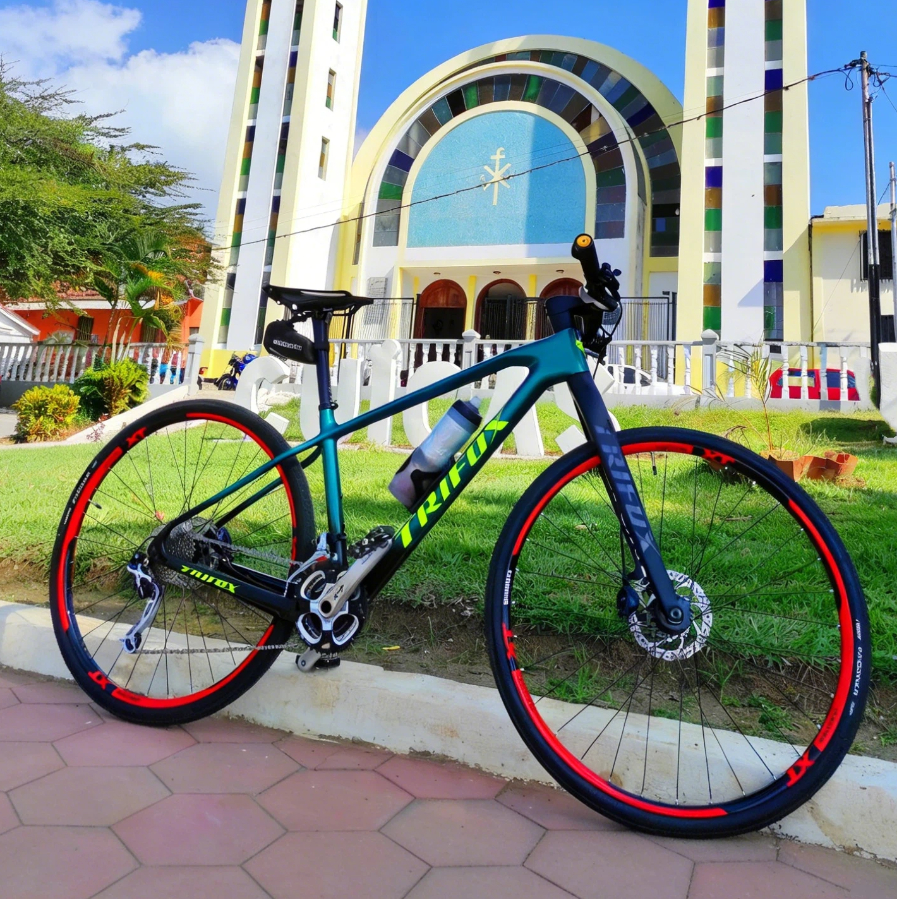
Built for Modern Performance and Clean Aesthetics
Whichever O.L.D version you select, every SDY21 shares the same high-performance DNA. The frame is constructed from T800 full carbon fiber, offering an exceptional stiffness-to-weight ratio. Weighing as little as 1028g in the 15.5" size, it's a true lightweight contender. The frame features full internal cable routing through the headset, resulting in a sleek, uncluttered appearance and protecting cables from the elements. Its modern geometry—with a 70° head tube angle and 73° seat tube angle—provides confident, capable handling that balances climbing efficiency with descending stability. Clearance for up to 29x2.4" tires ensures compatibility with modern, high-volume rubber.
The Perfect Platform for Singlespeed and Geared Builds
The SDY21's versatility extends to its drivetrain compatibility. It features replaceable derailleur hangers, making it a perfect candidate for a geared build. However, its design also lends itself exceptionally well to simplicity. For riders seeking a minimalist, low-maintenance machine, the frame is an ideal single speed bike frame. The vertical dropouts work well with chain tensioners, or you can opt for a singlespeed-specific hub and tensioner setup, creating a lightweight, efficient, and nearly indestructible trail companion.
In essence, the Trifox SDY21 offers the rare combination of choice and performance. By providing three distinct O.L.D versions, it empowers you to build the exact bike you want, without compromise. Whether you're building a classic QR-equipped trail bike, a modern Boost race machine, or a stripped-down single speed bike frame for rugged adventures, the Trifox rigid frame mtb SDY21 provides the perfect, lightweight carbon foundation.



