


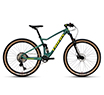

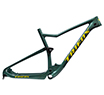
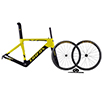
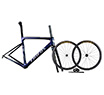
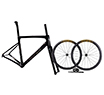
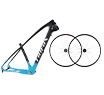
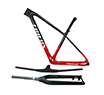





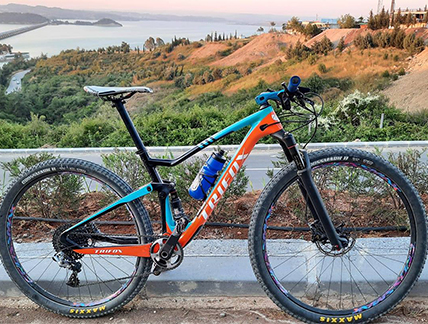
Walk into any bike shop or scroll through online forums, and you'll hear the same debate: carbon vs. aluminum. For hardtails, the choice is often straightforward. For full-suspension bikes, the decision carries more weight — literally and financially. Carbon full-suspension frames command a significant premium over their aluminum counterparts. But do you actually get what you pay for? To answer that, let's look at the real-world differences using the Trifox MFM100 xc full suspension bike frames as a benchmark — a frame that forces a conversation about value at its $699 price point.
The Weight Argument: Where Carbon Wins Every Time
The most obvious advantage of carbon is weight. The MFM100's T800 full carbon frame weighs just over 2kg (around 2,200g for a medium size). A comparable aluminum full-suspension frame often tips the scales at 2.8–3.2kg. That's a saving of 600g to 1kg — over two pounds — right at the center of the bike. For cross-country and trail riding, this translates to easier climbing, quicker acceleration, and less fatigue over long days. Riders who have built up the MFM100 describe it as "a missile, very fast and rigid", with "the force that you print to the pedals going directly to the wheels".
Ride Quality: More Than Just a Number on a Scale
Weight savings tell only part of the story. Carbon fiber's anisotropic nature — its ability to be stiff in one direction and compliant in another — allows engineers to tune the frame's ride characteristics in ways that aluminum cannot match. The MFM100 uses a Horst-link four-bar linkage with a Trunnion-mounted rear shock, creating a suspension curve that is efficient on climbs yet plush on descents. The result is a bike that "behaves very well, absorbing small irregularities in the terrain" while maintaining "an iota of rigidity and tracing all the way where you send it". Carbon's natural vibration damping also reduces trail chatter, keeping you fresher longer.
Modern Geometry and Standards
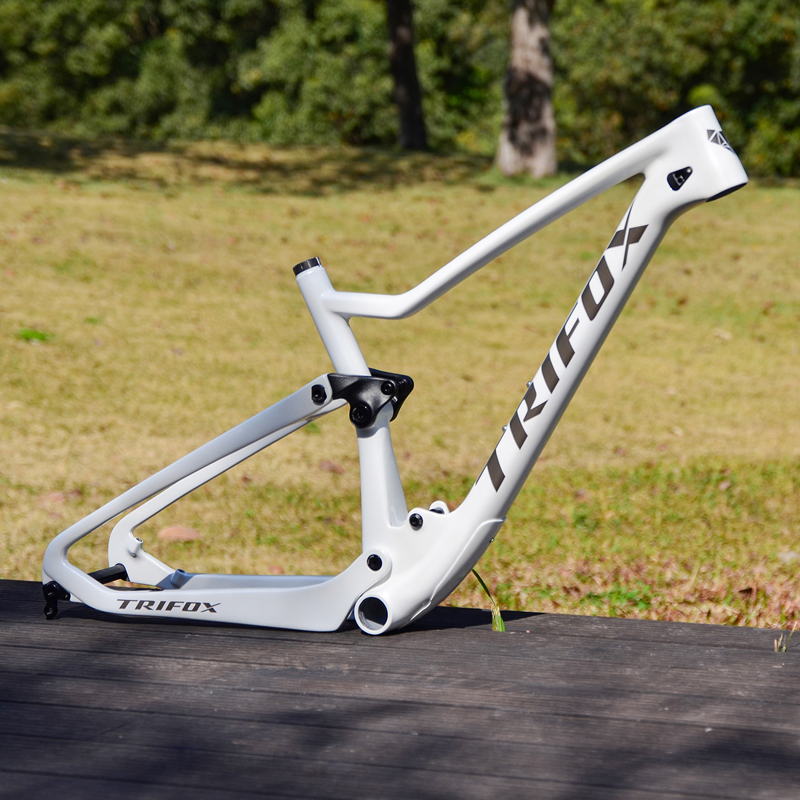
The MFM100 is built around a 68.5° head tube angle and a 74.7° seat tube angle — numbers that sit in the sweet spot between XC urgency and trail stability. It features Boost 148x12mm rear spacing, internal cable routing, and clearance for up to 29×2.35” tires. These are the standards that define a modern, capable trail bike. Aluminum frames at a similar price point often lack these features or use older standards that limit future upgrades.
The Cost Reality: Carbon Is Getting Cheaper
Here's where the calculus shifts. Historically, a carbon full-suspension frame cost $2,000–$3,000 or more. The MFM100, frequently available for $799–$999, undercuts that by a significant margin. In fact, it's cheaper than many high-end aluminum frames. At this price, the question isn't "is carbon worth it?" — it's "why wouldn't you choose carbon?"
The catch? Direct-to-consumer brands like Trifox eliminate retail markups, passing the savings to you. You get the frame, but you'll need to source your own shock, fork, and components. For the savvy builder with parts to transfer or a willingness to shop deals, the savings are substantial.
Who Is This Frame For?
The MFM100 is ideal for cross-country racers and trail riders who want efficient pedaling on climbs without sacrificing control on technical descents. It's for the rider upgrading from an entry-level hardtail, seeking the comfort and control of full suspension without a five-figure investment. And it's for value-conscious builders who want a modern, capable, lightweight full-suspension platform that won't break the bank.
Available in four sizes (15.5″, 17.5″, 19″, 20.5″) and multiple colors, including a clean white mtb frame option, the MFM100 offers a proper fit for a wide range of riders. One user, who has ridden the frame for almost two years, described it as "excellent quality" and "worth the money anywhere".
The Verdict: Yes, It's Worth It
Is a carbon full-suspension frame worth the extra cash? For the MFM100, the answer is a clear yes. At a price point that rivals aluminum frames, you get the weight savings, ride quality, and modern standards that carbon delivers — without the premium price tag. The real question isn't whether carbon is worth it. It's whether you're ready to build the bike you've been dreaming of. The Trifox MFM100 proves that you don't need a second mortgage to ride carbon.
2026-06-17
Trifox
SHARE:


Comments
Recent Posts
1
1
1
1
1
1
1
1
1
1
1
1
1
1
1
1
1
1
1
1
1
1
1
1



