



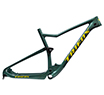
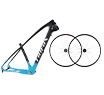
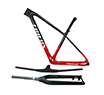
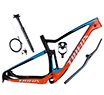
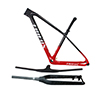
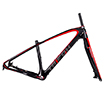





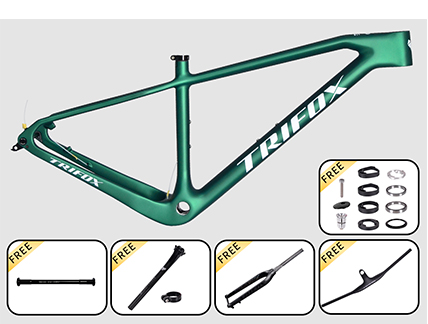
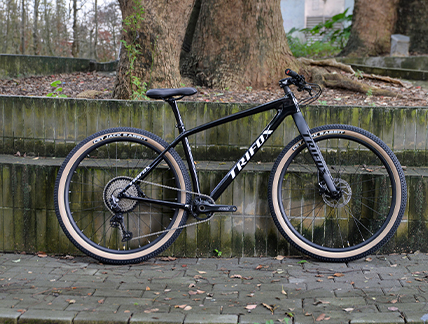
For any rider who's spent hours on the trail, the feeling is all too familiar: the relentless, high-frequency vibration from roots, rocks, and rough ground. This "trail buzz" doesn't just cause discomfort—it fatigues your hands, arms, and core, saps your energy, and can even blur your focus over time. Many riders assume that only a full-suspension bike can solve this. However, the frame material itself plays a profound and often misunderstood role. This is where carbon fiber, particularly in a hardtail like the Trifox M2, transforms the riding experience in a way that aluminum simply cannot.
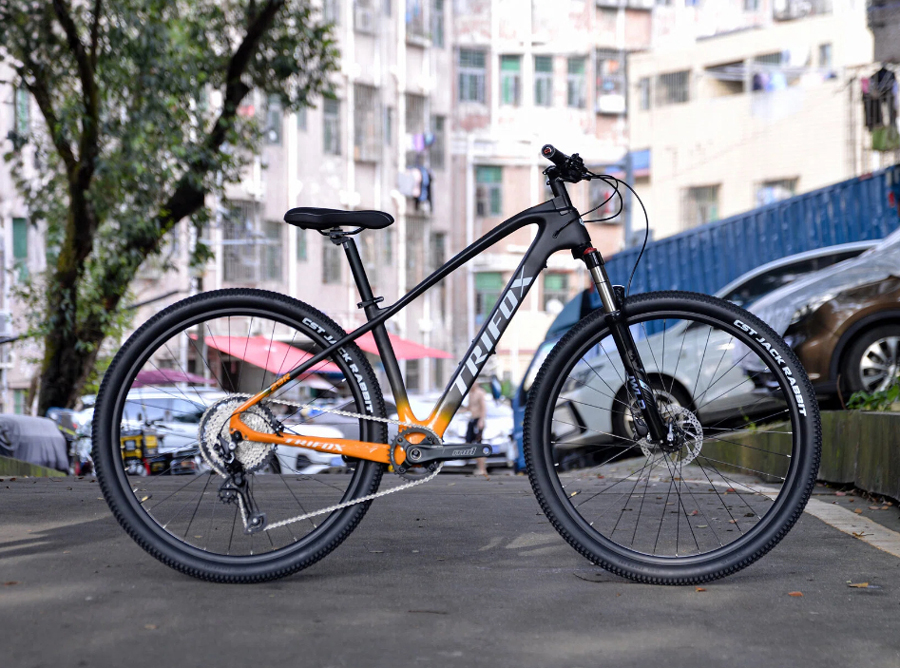
To understand why, we must move beyond simple metaphors of "stiffness" and look at material science. Aluminum is an isotropic material; it reacts uniformly to stress in all directions. When it encounters an impact, it transmits a sharp, high-frequency vibration wave directly through its structure and into the rider. Carbon fiber, in contrast, is a composite anisotropic material. It consists of thousands of individual carbon fibers set in a resin matrix. This structure allows it to be engineered with different properties in different directions. Crucially, the resin matrix acts as a microscopic damping agent. When vibration energy enters the carbon layup, it is dissipated as harmless heat within the resin and between the fiber layers, rather than being transmitted onward.
This isn't about making the frame "soft" or flexible in a way that compromises pedaling efficiency. A well-engineered carbon frame like the M2, built from high-modulus T800 carbon fiber, is exceptionally stiff under the large, powerful loads of pedaling and cornering. This ensures every watt of your effort translates to acceleration. However, its composite nature allows it to selectively filter the small, high-frequency vibrations that cause fatigue. It's the engineering equivalent of a noise-cancelling headphone for your bike—blocking the irritating "noise" of the trail while letting the clear "signal" of your power and control through.
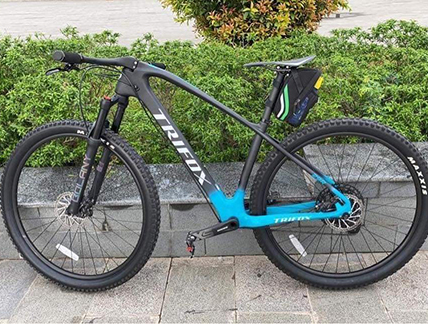
The result on the mtb trail is transformative. On an aluminum hardtail, you often feel every single texture of the ground. On a carbon hardtail like the M2, the harsh edges of those sensations are rounded off. The bike feels plush and connected, not harsh and jarring. This has a direct performance benefit: with less muscle tension required to simply hang on, you have more energy to pedal, brake, and steer precisely. Your grip on the handlebars can be lighter, your vision stays clearer, and you can ride harder for longer.
This is the true magic of a modern carbon mtb bike. It's not just a weight-saving upgrade. It's a holistic improvement in ride quality that redefines what a hardtail is capable of. By mastering the physics of vibration damping, carbon fiber delivers a dual promise: unshakable efficiency when you're putting power down and remarkable comfort that lets you conquer mile after mile of technical terrain. The Trifox M2 embodies this, proving that the right material doesn't just change the bike's specs—it changes the entire experience of the ride.
2026-01-16
Trifox
SHARE:


Comments
Recent Posts
1
1
1
1
1
1
1
1
1
1
1
1
1
1
1
1
1
1
1
1
1
1
1

1



